What data can our AI read, and what can our AI agents do?
A model is only as risky as what it can reach.
Onam links each AI service to the identity it runs as and the data stores it reads, so you can see what an AI finding puts at risk.
- CIEM
- DSPM
How do I see what one AI agent can reach?
Pick it, and look both ways: the role it runs as on one side, the stores it reads on the other.
- ⚠ Finding: Wide write access
- Marked as an AI agent in CIEM
- customer-ticketsS3 · holds personal data (DSPM label)
How does Onam know which data an AI service reads?
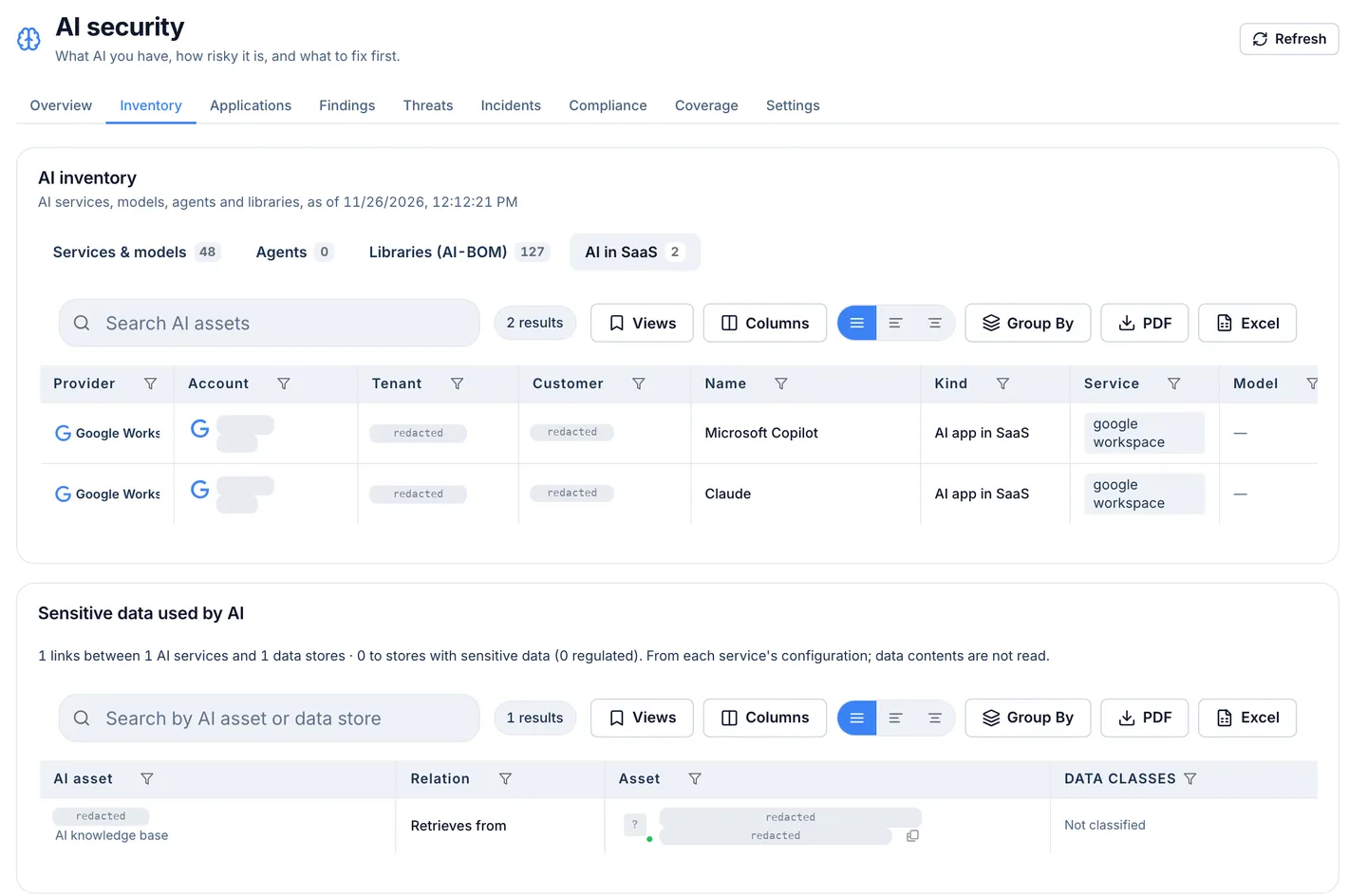
For each AI service, Onam records which data stores it reads, as a link between the AI resource and the store. DSPM labels the same stores, so a link to a store holding personal or other sensitive data tells you this AI reads sensitive data.
The link records that an AI service uses a store, from the service's configuration. It does not read the data.
Why treat AI agents as identities?
Because an agent acts through a role, and an over-powered role turns a prompt-injection problem into an account takeover. In CIEM, Bedrock and SageMaker roles and other AI execution identities are marked as AI agents, so you can review them as a group.
| Finding | Why it matters |
|---|---|
| AI agent with admin access | An agent that can do anything turns a prompt-injection or tool-misuse problem into an account takeover |
| AI agent with wide write access | An agent that can write or delete across many resources can damage data and infrastructure it never needed |
| More tools than the limit | An agent with more tools than the limit set in Settings gets a finding |
Where Onam can resolve the identity an AI workload runs as, the workload also shows that identity's risk, from Onam's IAM analysis. Right-sizing follows the normal right-sizing workflow.
Does Onam watch what our AI does at run time?
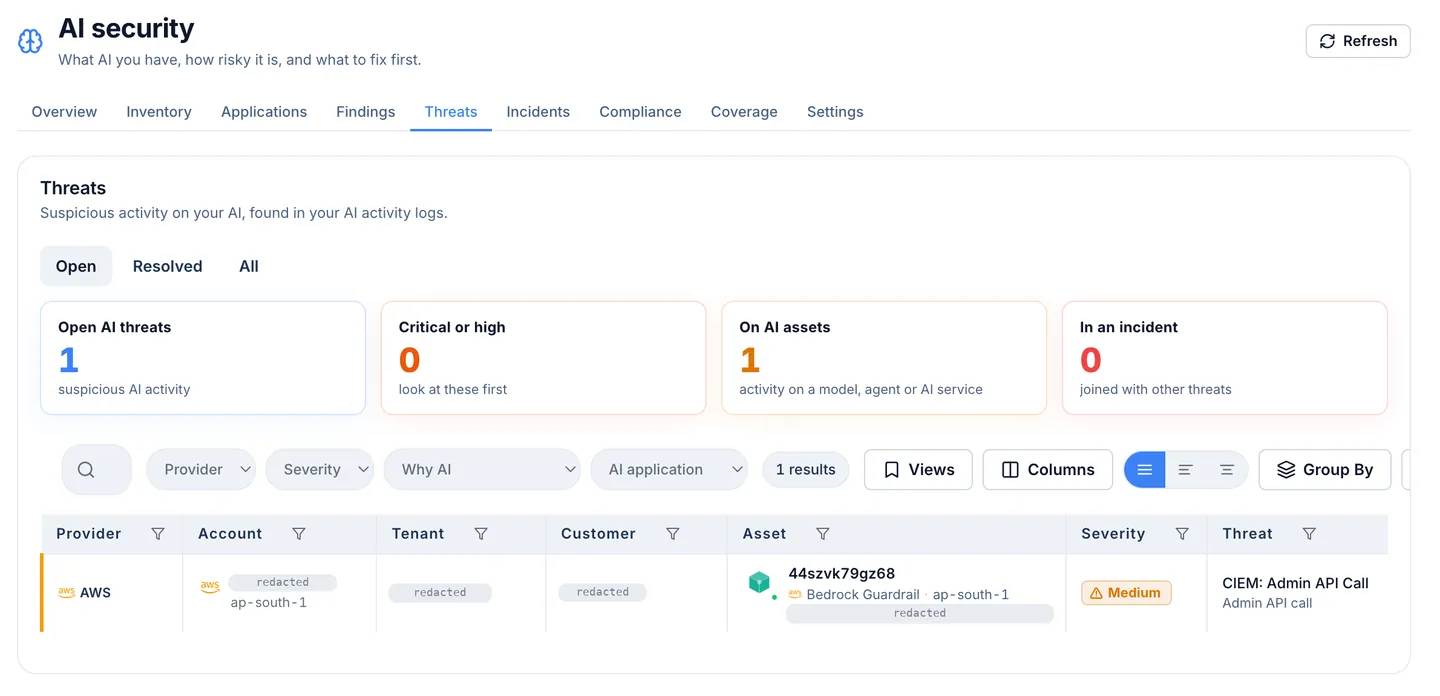
Partly. AI Security's Threats tab shows suspicious activity on your AI assets, found in your AI activity logs by Onam threat detection. The rest of AI Security is posture: what your AI is allowed to do and what it can reach.
What it checks
- Which data stores each AI service reads, with DSPM's sensitivity labels
- AI execution identities marked as AI agents, with admin and wide-write findings
- The identity risk on AI workloads, where the identity can be resolved
- Suspicious activity on AI assets, on the Threats tab
What it does not do (today)
- Draw multi-hop paths: AI is not on attack paths yet
- Join SAST findings to AI applications: they stay in Code security
- See data reached in ways the scan cannot see, such as credentials embedded in code
- Edit IAM: removing access from an AI agent is your change
Keep going
Questions customers ask
Can Onam tell us which models were trained on customer data?
Onam shows which data stores each AI service reads. If DSPM has classified those stores as holding personal or other sensitive data, you see the combination. It does not inspect the model itself.
Our Bedrock agent has a role with AdministratorAccess "just for the demo". Will Onam flag it?
Yes. The role is marked as an AI agent and its admin access raises a finding.
Does Onam read the data our AI uses?
No. AI Security links an AI service to a store from the service's configuration. Classification of the store itself is DSPM's job, on the stores you choose. See DSPM classification.