Are my AI workloads introducing security risks I haven't thought about?
AI security posture for the AI in your clouds, and the AI you run yourself on Kubernetes.
SageMaker and Bedrock on AWS, Azure OpenAI and Azure Machine Learning on Azure, Gemini Enterprise Agent Platform (formerly Vertex AI) on Google Cloud, and model servers, notebooks and vector databases on your own Kubernetes clusters: AI has its own settings, identities and data paths. Onam finds the AI in your estate and checks how each piece is set up, read-only and with no agent.
- clouds for managed AI: AWS, Azure, Google Cloud
- 3
- self-hosted AI: inventory and exposure
- K8s
- AI frameworks mapped
- 4
- agents installed: read-only
- 0
A data scientist starts a SageMaker notebook to test a model.
Unless it is placed in a VPC, it has direct internet access by default; its execution role often holds far more rights than the test needs; and its training data comes from a bucket the security team has never reviewed. Multiply that by every experiment in your organisation.
The whole picture
From the AI in your clouds to its risky settings
Onam finds the AI in your clouds and on your clusters, checks how each piece is set up, and links it to the data and identity it uses.

 Microsoft Azure

 Kubernetes
- Your SBOMsFor the AI BOM
Finds the AI and checks its setup
- 1Inventory AI resources
- 2Build the AI BOM
- 3Run AI-native rules
- 4Join data and identity
Configuration checks, read-only, no agent
Exposed, unguarded, and reading data
- AI inventoryCloud and self-hosted
- AI bill of materialsLibraries, servers, MCP SDKs
- Guardrail presenceModels, deployments, agents
- Exposed self-hosted AINo authentication
- AI-to-data linksWhich stores each reads
- AI agents as identitiesAdmin and wide write
Covers AWS, Azure, Google Cloud and Kubernetes; not Oracle, Alibaba or IBM Cloud. Prompt-text detection is off by default.
How AI Security (AI-SPM) works
From AI discovery to one findings queue
Read-only APIs find SageMaker, Bedrock and model artifacts on AWS, Azure OpenAI and Azure Machine Learning, and Vertex AI endpoints, datasets and Workbench on Google Cloud.
- AWS
- Azure
- Google Cloud
In each connected Kubernetes cluster, read through a read-only ServiceAccount, a classifier finds model servers, notebooks and vector databases and checks for exposure without authentication.
- Ollama
- vLLM
- Qdrant
AI libraries, model servers and MCP SDKs are picked out of the SBOMs Onam already builds for your code and images.
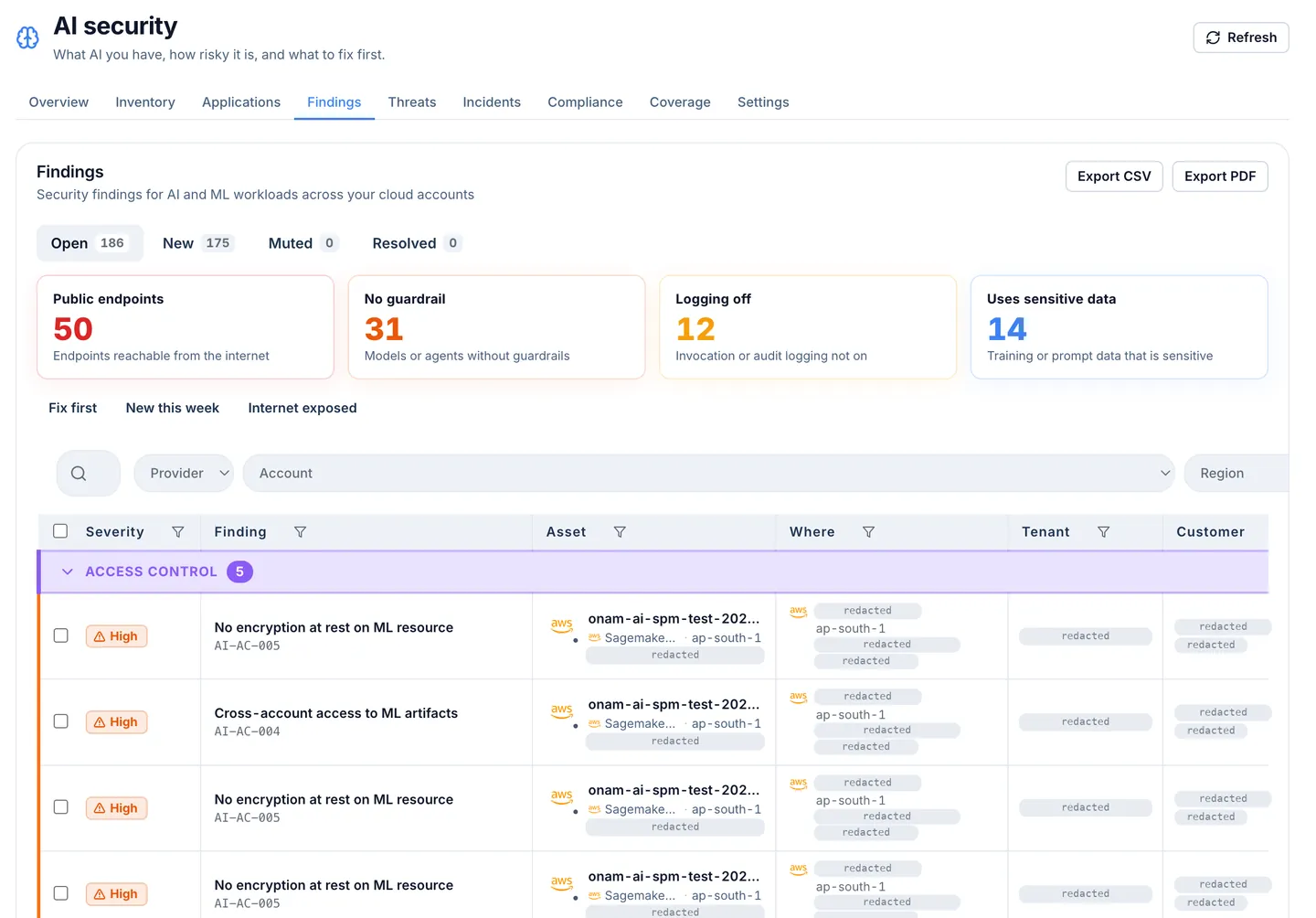
AI-native rules check network isolation, execution-role scope, artifact encryption and inference and training logging, and whether a provider guardrail is attached.
Guardrail presence, not strength
Each AI service is joined to the data stores it reads and the identity it runs as, and findings join the platform's findings queue.
Prompt-text detection off by default
What you get
What AI security posture shows your team
One AI inventory, cloud and cluster
Cloud AI services, self-hosted AI on Kubernetes and AI apps in connected SaaS in one inventory, plus an AI bill of materials.
Includes: AWS, Azure, Google Cloud, Kubernetes.
Guardrail presence in one view
Whether a provider guardrail is attached to your models, deployments and agents. This shows presence, not strength.
Includes: Bedrock Guardrails, Azure content filters, Google Model Armor.
Exposed self-hosted AI found
Model servers, notebooks and vector databases on Kubernetes that are exposed without authentication.
AI identity and data links
The data stores each AI service reads, and AI execution identities marked as AI agents, with admin and wide-write findings.
Coverage you can check
A Coverage tab shows, per AI product, what Onam can and cannot see.
Findings mapped to AI frameworks
Mapped to OWASP Top 10 for LLM Applications 2025 and three more. A mapping is evidence for some controls, not a verdict.
Includes: NIST AI RMF, ISO/IEC 42001, EU AI Act.
Questions we get a lot
Which AI services are covered today?
AWS: SageMaker and Bedrock. Azure: Azure AI services accounts, including Azure OpenAI, and Azure Machine Learning workspaces. Google Cloud: Vertex AI endpoints, datasets and Workbench instances. Kubernetes: self-hosted model servers, notebooks, vector databases and serving resources on any connected cluster, for inventory and exposure; configuration rules for self-hosted AI are written but not switched on yet. AI services on Oracle Cloud, Alibaba Cloud and IBM Cloud are not checked.
Why does AI security need a separate engine if I already have CSPM?
AI services add settings that matter only for AI: network mode of endpoints, execution role scoping, artifact encryption, invocation logging, guardrails. AI Security reads them as AI, applies AI-specific rules, finds the AI teams run themselves, and puts the findings in the same queue as everything else. AI services are not drawn onto attack paths yet.
What about Azure and Google Cloud AI services?
Both are covered, proven on live Azure and Google Cloud accounts in October 2026. On Azure, Onam checks Azure AI services accounts (including Azure OpenAI) and Azure Machine Learning workspaces: public network access, key-based sign-in, logging, managed identity and customer-managed keys. On Google Cloud, it checks Vertex AI endpoints, datasets and Workbench instances: public access, customer-managed keys, request logging, public IPs and default service accounts. AWS has the longest list of services.
Does Onam read our prompts or model data?
Not by default. AI Security works from configuration and metadata: what the cloud APIs report about each AI resource, what the Kubernetes API reports about each workload, and the package lists in your SBOMs. Reading prompt and answer text, to find prompt injection, jailbreaks and sensitive answers, is a setting called prompt-text detection; it is off unless an admin turns it on. Onam never reads training data or model weights.
Do AI security findings appear in compliance reports?
Yes. AI findings sit in the same findings queue and exports as the rest of the platform. In Compliance, they map to OWASP Top 10 for LLM Applications 2025, NIST AI RMF, ISO/IEC 42001 and the EU AI Act, where some controls are partly automated (an Onam rule checks them) and the rest you attest. MITRE ATLAS is used for the threat model, and OWASP Agentic 2026 is not scored yet. A mapping links findings to controls; it does not mean every control is checked automatically.
See AI Security (AI-SPM) on your own cloud
Book a 30-minute demo. We walk through it on sample data, or on one of your accounts if you want to connect it.