The specialist agents
Onam Operations has eight specialist agent roles, each with a declared job, level, skills, tools and limits. Automation works in two modes: planner and actor.
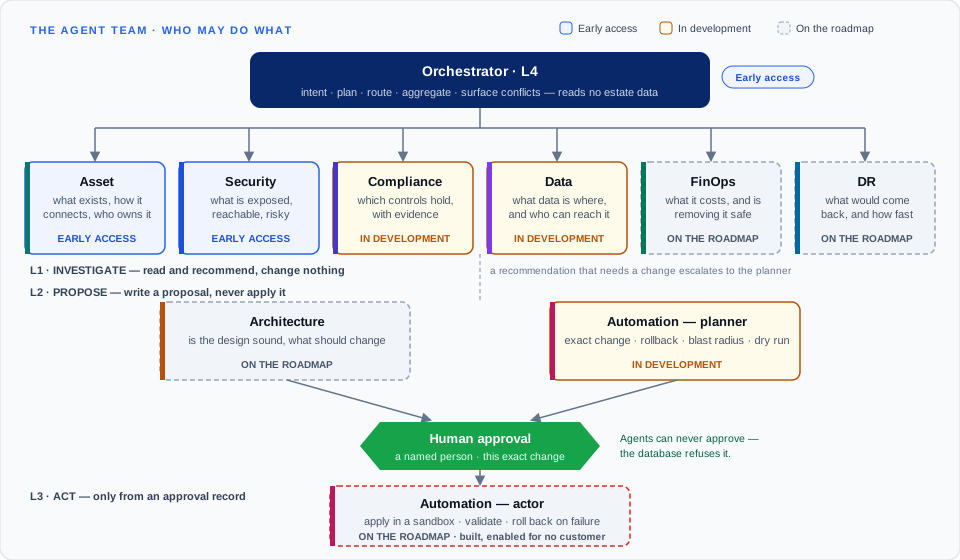
The roster
| Agent | Level | Answers | Status |
|---|---|---|---|
| Asset Agent | L1 · Read and recommend | What do we have, how is it connected, and who owns it? | Early access |
| Security Agent | L1 · Read and recommend | What is exposed, how can it be reached, and how bad is it? | Early access |
| Compliance Agent | L1 · Read and recommend | Which controls hold, which do not, and where is the evidence? | In development |
| Data Agent | L1 · Read and recommend | What data is where, how sensitive is it, and who can reach it? | In development |
| Automation Agent — planner | L2 · Propose | How exactly should this be changed, and how do we undo it? | In development |
| Automation Agent — actor | L3 · Execute an approved change | Apply exactly what was approved, check it worked, undo it if not. | On the roadmap |
| FinOps Agent | L1 · Read and recommend | What does it cost, where is the waste, and is removing it safe? | On the roadmap |
| DR Agent | L1 · Read and recommend | What would actually come back after a failure, and how fast? | On the roadmap |
| Architecture Agent | L2 · Propose | Is this design sound, and what will a change break? | On the roadmap |
How agents escalate
Escalation is upward-only and explicit. An investigating agent that finds something needing a change hands it to the Automation planner through the orchestrator; it never acquires the capability itself. Ambiguity goes to a person. Conflicts go to the orchestrator, which shows them to you.
How an agent is certified
No agent is enabled until it passes four gates, each producing a recorded artifact:
- Scope review — every skill, tool and permission is necessary, and the narrowest that works.
- Security review — the prompt-injection test corpus passes in full; no path to an unregistered tool; cross-customer tests pass.
- Evaluation — accuracy, groundedness, tool success and cost per task meet declared floors on test estates.
- Documentation — purpose, capabilities and known limits written for customers. An agent with no documented limits has not been examined.