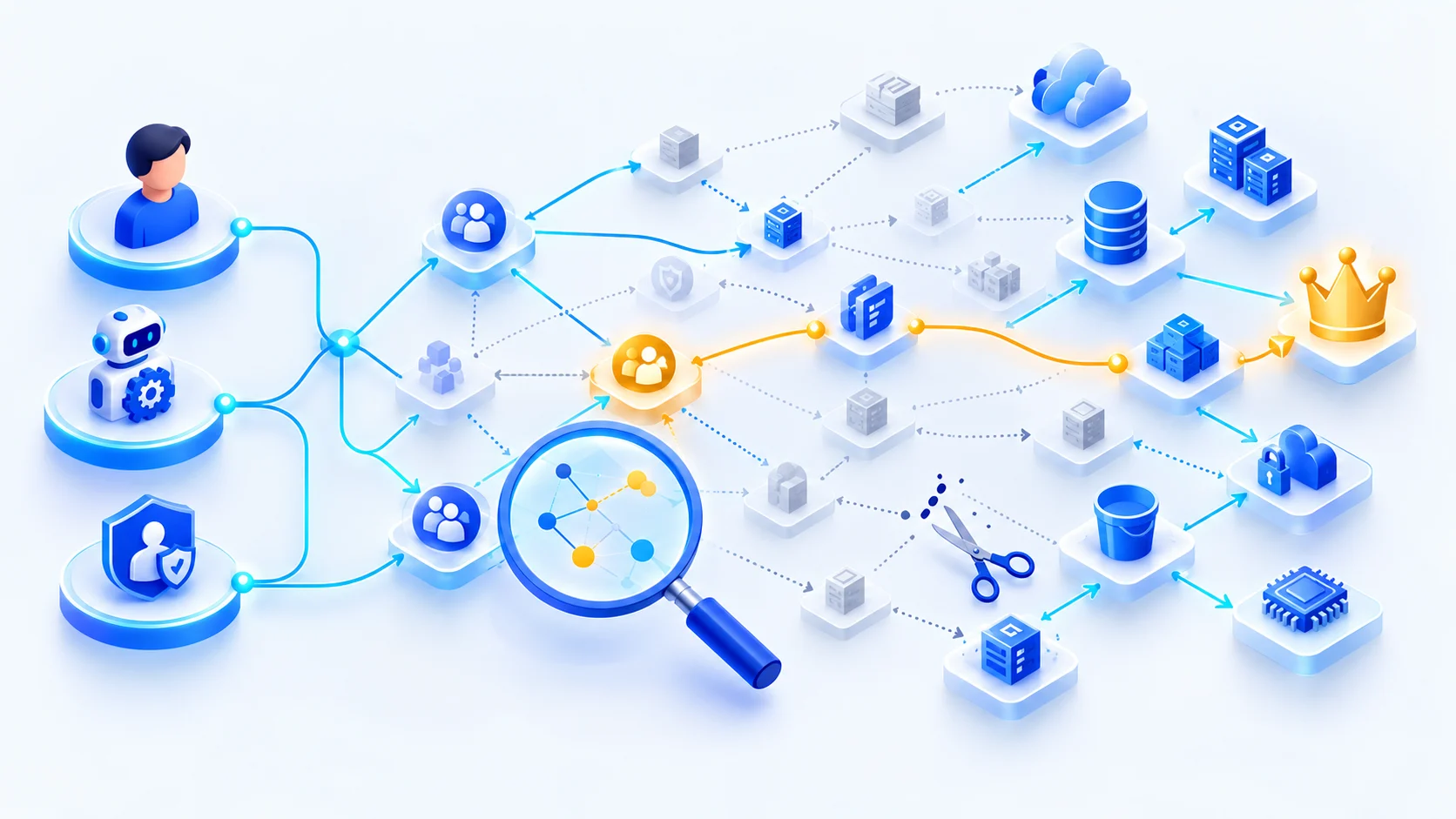
Nobody can answer 'what can this role actually do?' by reading its policy.
The answer depends on the groups it inherits from, the explicit denies elsewhere, the conditions on each statement and the SCP above the account. And the risk is rarely the role that looks like an admin. It is the CI role with iam:PassRole on a wildcard, the forgotten role that trusts an external account without an ExternalId, or the Kubernetes service account that can create pods/exec. CIEM is the work of resolving that per identity, then ranking what to fix first.
The identity you don't see as admin
Shadow admins never hold an admin policy. They hold the permission that lets them grant themselves one — AttachRolePolicy on a wildcard, CreatePolicyVersion with SetDefaultPolicyVersion, or PassRole to a role that already is admin.
CIEM in two minutes
Voices are AI-generated. More short Q&A videos: Onam Security: cloud security
The mechanism, not the marketing
- 1
Identities and policies come from the cloud inventory Onam's posture scan already builds — IAM users, roles, groups, policies and trust policies on AWS; role definitions and assignments, service principals and managed identities on Azure; IAM bindings, service accounts and workload identity pools on GCP; RBAC bindings and service accounts on Kubernetes; and the identity services of OCI, Alibaba Cloud and IBM Cloud.
- 2
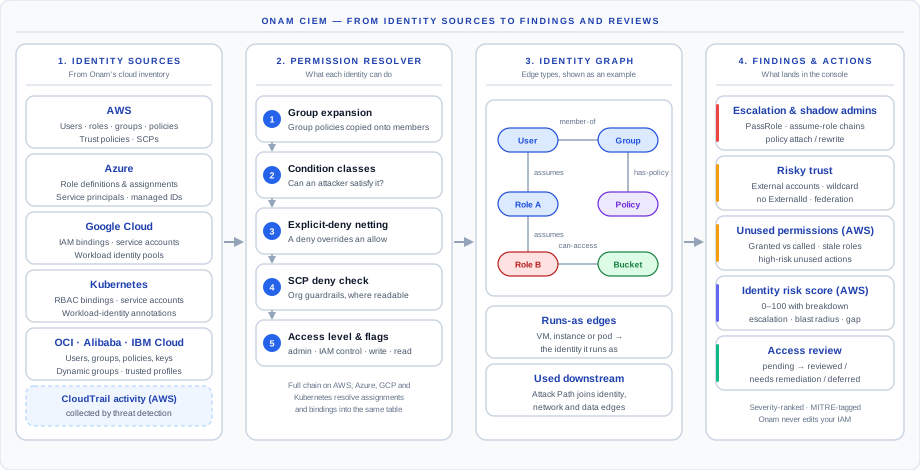
Effective access is resolved per identity. On AWS, group policies are copied onto each member, every condition is classified by whether an attacker could satisfy it, explicit denies are netted out and SCP deny statements are checked. Azure role assignments (with their scope), GCP bindings and Kubernetes RoleBindings resolve into the same effective-access table.
- 3
Each grant gets an access level — admin, IAM control, write, read, list or tagging — and is flagged when it is admin-equivalent, cross-account or blocked by an SCP.
- 4
Identity relationships — has-policy, member-of, assumes and can-access on AWS, plus the link from a VM, instance or pod to the identity it runs as — are written into the platform's security graph, which Attack Path and blast-radius analysis read.
- 5
Detectors look for privilege escalation: PassRole to an admin role, multi-hop assume-role chains that reach admin, permission-boundary removal and shadow admins on AWS, plus escalation vectors for Azure, GCP, OCI, IBM Cloud and Kubernetes.
- 6
On AWS, CloudTrail activity collected by threat detection is joined to the granted actions: roles with no recent activity are flagged as stale, and each identity gets a permission gap — the share of granted actions it never called — with the high-risk unused ones listed.
- 7
AWS identities get a 0–100 risk score from escalation paths, recent use of escalation operations, blast radius and permission gap. Identities in the high tier open an access review with the evidence attached.
Specific outputs, measurable outcomes
From identity sources to a decision
CIEM reads the identities Onam's posture scan already inventories, resolves what each one can do, records how they connect, and turns that into findings a person can act on.
What CIEM works out, and where
Each card says which clouds it runs on today. AWS has the deepest coverage; we would rather say that than let a checkmark imply otherwise.
Effective permissions
Group policies are copied onto each member, conditions are classified by whether an attacker could meet them, explicit denies override allows, and SCP deny statements are checked. Each grant is labelled admin, IAM control, write, read, list or tagging.
AWS in full · Azure, GCP and Kubernetes assignments and bindings
Identity graph
Has-policy, member-of, assumes and can-access edges, plus the link from a VM, instance or pod to the identity it runs as. Attack Path and blast-radius analysis read the same graph.
AWS identity edges · runs-as links on Azure, GCP and Kubernetes
Escalation paths and shadow admins
PassRole to an admin role, multi-hop assume-role chains, permission-boundary removal, and identities that can attach or rewrite their way to an admin policy — plus each cloud's own escalation vectors.
AWS, Azure, GCP, OCI, IBM Cloud, Kubernetes · shadow admins on AWS
Cross-account and federated trust
Role trust policies checked for foreign accounts, wildcard principals, a missing ExternalId and OIDC or SAML federation, including from GitHub, GitLab, GCP and Azure.
AWS in depth · cross-tenant, trusted-profile and RAM trust checks elsewhere
Non-human identities
Roles classified by who can assume them — AWS services, execution roles, CI/CD over OIDC, EKS service accounts, cross-account principals. Managed identities, service accounts and Kubernetes service accounts are resolved like users.
AWS, Azure, GCP, Kubernetes
Unused permissions
CloudTrail activity collected by threat detection is compared with granted actions. You get a permission gap per identity, the high-risk unused actions such as iam:PassRole or kms:ScheduleKeyDeletion, and a list of roles with no recent activity.
AWS today
Risk score and access reviews
A 0–100 score built from escalation paths, recent escalation activity seen by CDR, blast radius and permission gap. High-tier identities open a review: pending, needs remediation, reviewed or deferred, with an audit trail.
AWS identities today
Read the CIEM docs
How effective permissions are computed, every finding type, the right-sizing workflow and per-cloud notes.
What runs on which cloud today
| Capability | AWS | Azure | GCP | K8s | OCI | Alibaba | IBM |
|---|---|---|---|---|---|---|---|
| Effective-access table | |||||||
| Escalation detection | |||||||
| Multi-hop assume-role chains | |||||||
| Shadow admin detection | |||||||
| Trust and federation checks | |||||||
| Unused permissions and stale roles | |||||||
| Risk score and access reviews | |||||||
| Identity hygiene (IAM Security) |
Identity hygiene — MFA, key age, password policy, root usage — is covered on all seven clouds through IAM Security, which shares this engine and inventory.
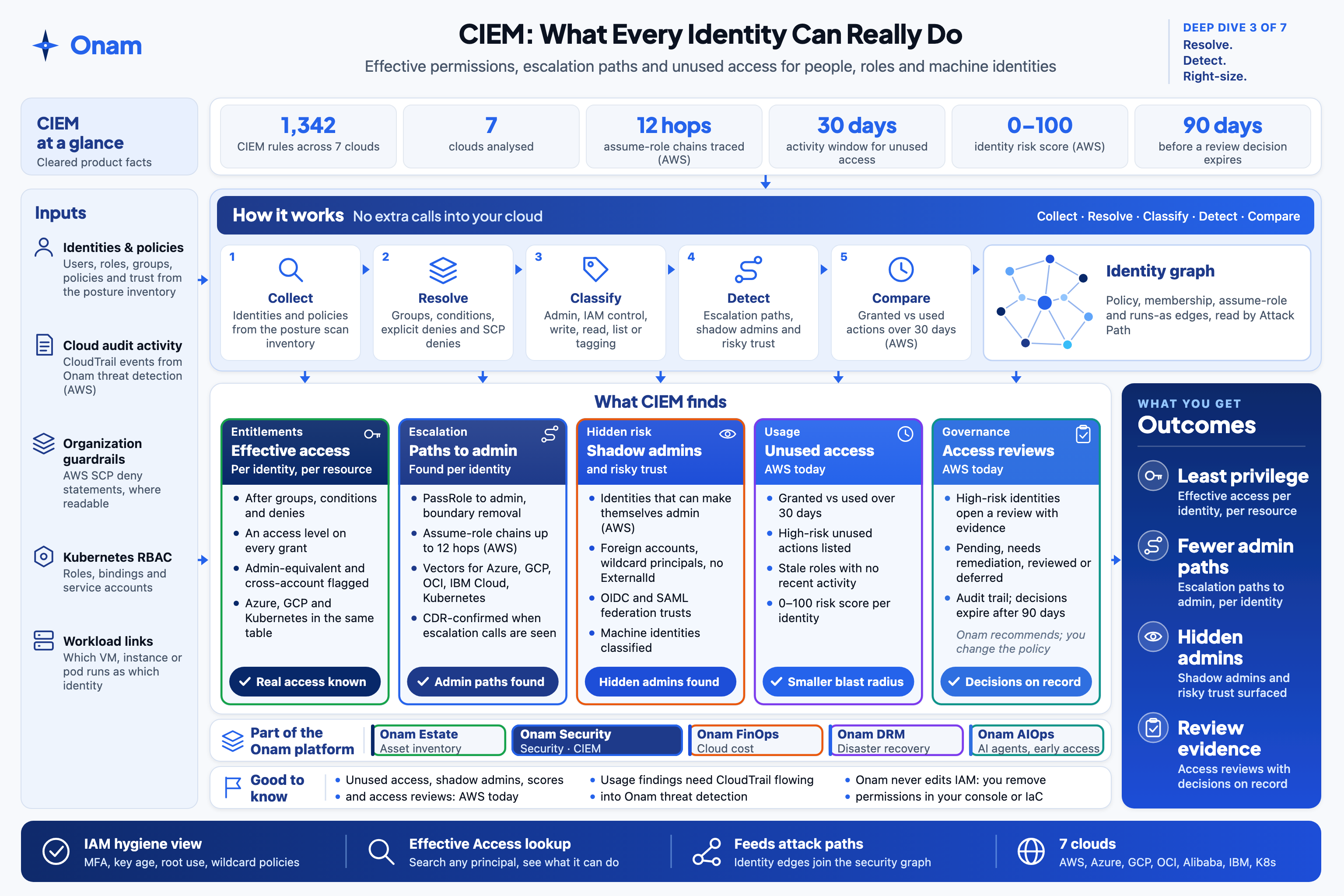
CIEM on one page
Inputs, how it works, what you get and the limits — the same sheet our team uses in briefings.
 Open full size
Questions we get a lot
Ready to see CIEM in your cloud?
Connect a read-only role in three minutes. Your first findings surface in under five.