Onam Security
Dependencies & SBOM (SCA)

Which of our dependencies are actually being exploited, and can we prove what we ship?

Know what you ship, and which of it attackers are using right now.

Onam reads your manifests and lockfiles, matches every component against OSV and NVD, ranks each vulnerability by exploitation signals as well as severity, and gives you a CycloneDX SBOM with license, VEX and NTIA checks on top.

SAST
source code
SCA + SBOM
dependencies
IaC
templates
DAST
running apps
Why this matters

A customer's procurement team asks for an SBOM.

Engineering exports a list of packages from one service, by hand, in a format nobody agreed on. The same week a dependency report lands with dozens of CVEs sorted by CVSS, and the team patches the top of the list — a 9.8 nobody has ever exploited — while a medium-rated library on CISA's known-exploited list ships in every build.

CVSS is not a to-do list

Severity describes the vulnerability, not how likely anyone is to use it against you. A queue sorted by CVSS alone spends the week on theoretical criticals while an actively exploited medium waits.

Ranked by exploitation, not only severity
How does it actually work?

The mechanism, not the marketing

  1. 1

    Onam parses manifests and lockfiles itself, without an external scanner: Python (requirements files, Pipfile.lock, pyproject.toml, setup.cfg), npm (package.json, package-lock.json, yarn.lock), Java (pom.xml, Gradle build files), Go (go.mod), Rust (Cargo.toml, Cargo.lock), Ruby (Gemfile.lock), .NET (project files, packages.config) and PHP (composer.lock). Where a lockfile exists, its pinned versions win over the manifest.

  2. 2

    Each component is matched to known advisories — the OSV database first, the NVD as a fallback — using the same advisory store as Onam's vulnerability engine.

  3. 3

    Every match is enriched with its EPSS score (the probability of exploitation in the next 30 days) and whether it is on CISA's Known Exploited Vulnerabilities list, both refreshed daily.

  4. 4

    A composite 0–10 risk score combines CVSS, EPSS, KEV membership and whether a fixed version exists, and maps it to a priority: Immediate, High, Medium or Low. An actively exploited medium can outrank an unexploited critical — which is the point.

  5. 5

    The component list is written out as a CycloneDX 1.5 SBOM with package URLs. You can also upload an existing CycloneDX (1.4 or 1.5) or SPDX 2.3 SBOM in JSON and get the same enrichment, compare two SBOMs, record VEX statements, and run license-policy and NTIA minimum-elements checks.

What do you actually get?

Specific outputs, measurable outcomes

Native parsing across ecosystems
Python, npm, Java, Go, Rust, Ruby, .NET and PHP
Exploitation-aware ranking
EPSS and CISA KEV next to CVSS, in one 0–10 score
Fixed-version awareness
a vulnerability with an upgrade available is ranked as actionable
CycloneDX 1.5 SBOM
generated from the repository, JSON, with package URLs
SBOM import
bring CycloneDX or SPDX JSON from another tool and enrich it
SBOM diff
what was added, removed or changed between two SBOMs
VEX statements
record not affected, affected, fixed or under investigation, with a reason
License policy
permissive, weak-copyleft and strong-copyleft classification and built-in policies
NTIA minimum elements
each SBOM scored against the US baseline for SBOM content
The flow, in one picture

How Dependencies & SBOM (SCA) fits together
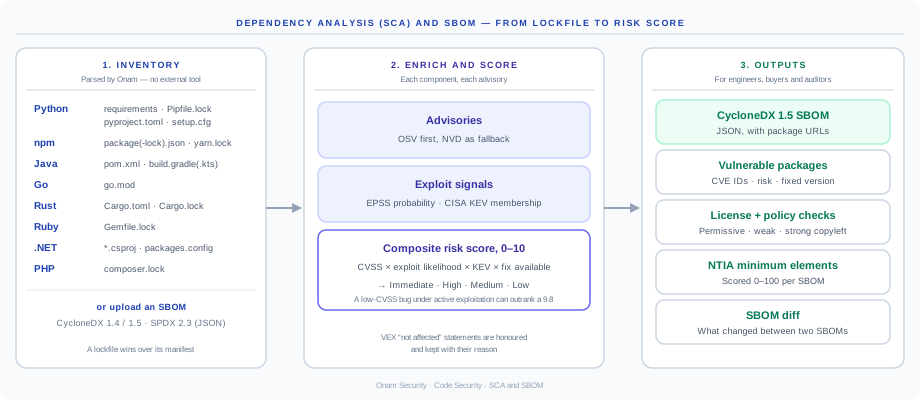
Manifests and lockfiles become a component list, enriched with OSV, NVD, EPSS and CISA KEV into a 0–10 risk score, with SBOM, license, NTIA, VEX and diff outputs
From lockfile to risk score. The same component list becomes the SBOM.
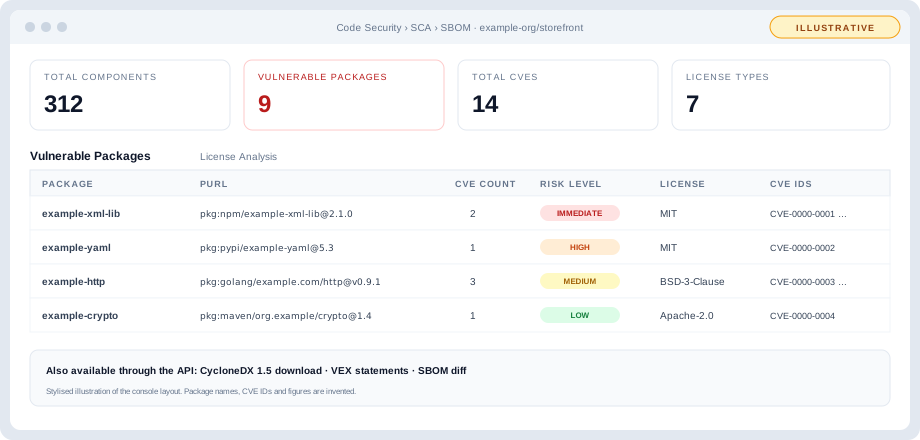
Illustrative layout of an SBOM result: component and CVE tiles above a vulnerable packages table
Illustrative — a stylised view of an SBOM result, not a screenshot. Package names and figures are invented.
FAQ

Questions we get a lot

It records what the lockfile pins, and a lockfile lists transitive packages as well as direct ones — so with package-lock.json, yarn.lock, Pipfile.lock, Cargo.lock, Gemfile.lock or composer.lock, transitive dependencies are covered. From a manifest alone (for example a requirements file without pins, or go.mod), only what the manifest declares is known.
Ready to see it live

Ready to see Dependencies & SBOM (SCA) on your dependencies?

Send us a repository or an existing SBOM. We will show you the risk-ranked component list and the SBOM it produces.