In what order does each application come back — and is that fast enough?
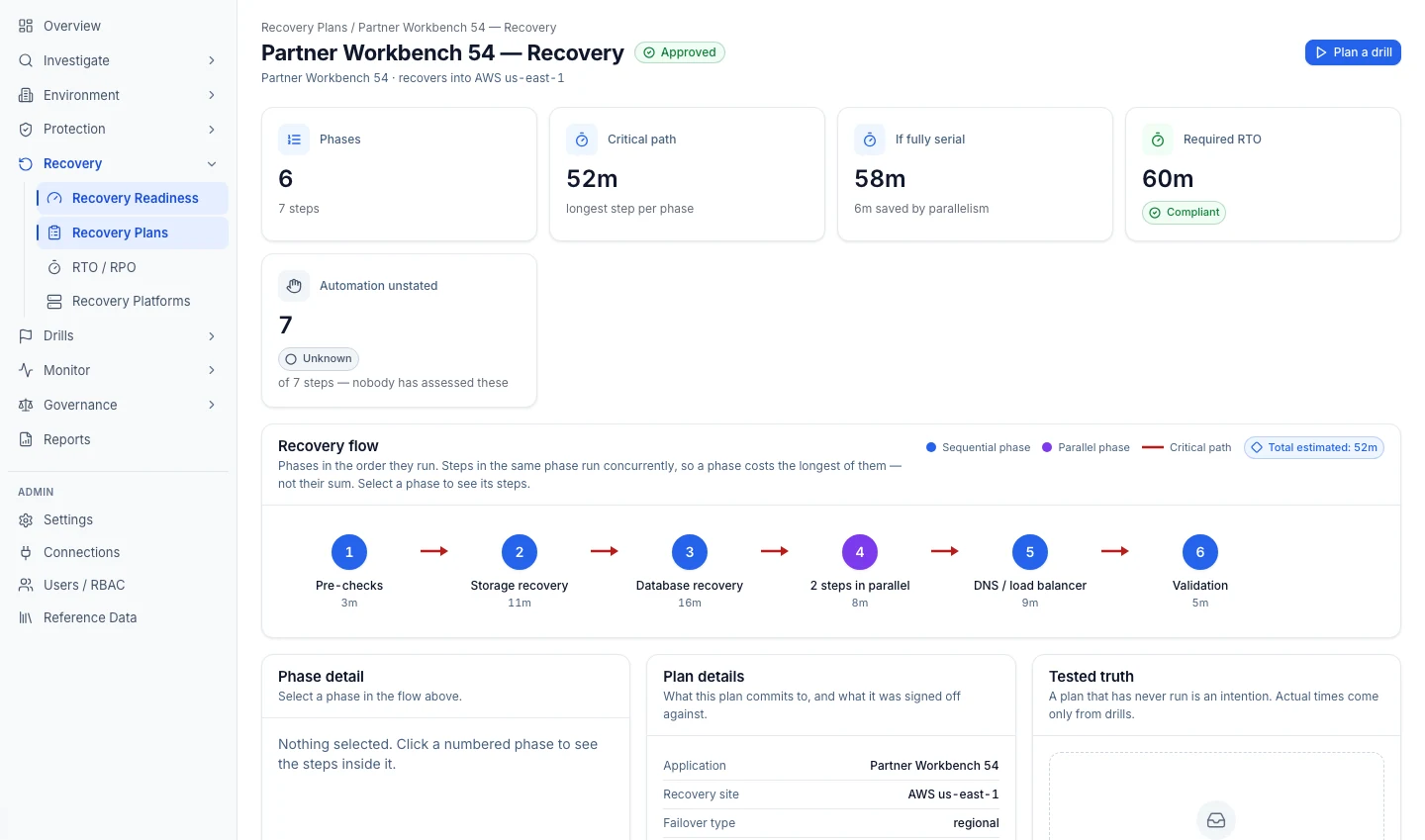
Onam DRM composes each application's recovery plan from approved applications, dependencies and protection: ordered steps, the steps that can run at the same time, and the critical path that sets how long it should take.
In your words
The runbook lists a start-up order someone wrote down years ago. Since then services have moved, new dependencies have appeared and nobody has re-checked the sequence. The plan says the application comes back in an hour, but nobody can show where that hour comes from — or which step will hold everything else up.
What Recovery plans shows you
Described from the product documentation — what the view holds, not what we hope it will.
Ordered steps
Steps follow the recovery-order dependencies between the application's parts, grouped into phases in the order they run.
Parallel groups and the critical path
Steps that can run at the same time are grouped, and the critical path — the longest chain that must run one after another — is shown against the fully serial time.
Where each step's position came from
Every step says whether its place came from a discovered dependency or from convention. A step placed by convention is a prompt to check the order with the application's owner.
Readiness against your targets
Each application is rated ready, warning, at risk or not ready, setting its predicted figures against the required RTO and RPO you entered.
An executive resilience scorecard
Four plain questions per application: does a plan exist, is it within the required RTO, is it governed by a baseline, and has it been proven by a drill?
The mechanism, step by step
What Recovery plans does, in the order it does it.
- 1Approve the inputs
Plans are composed from approved items only. Nothing an engine has merely proposed can shape a plan.
- 2Compose the order
DRM orders the steps from recovery-order dependencies, groups those that can run in parallel and finds the critical path.
- 3Approve the plan
A composed plan arrives in the Approval Center like any other proposal, and is approved by someone with approval rights.
- 4Predict and rate
Predicted RTO is the critical path through the approved plan, and readiness compares it with the required RTO and RPO you set.
- 5Carry it out with your own tools
The recovery itself, and any test of it, runs in your own tooling and runbooks. Record the drill in DRM to compare what happened with what was predicted.
What it does not do
Knowing where a capability stops is part of deciding whether to buy it.
It does not execute a recovery
DRM plans, predicts and records. It does not fail anything over or start a recovery in your environment — your own tools and runbooks do that.
It does not run DR tests
Drills run with your own tools are recorded in DRM, with the measured result set against the prediction captured when the drill was planned.
Questions about Recovery plans
More in Onam DRM
Applications & dependencies
Which applications do we actually recover, and what does each one depend on?
Explore Applications & dependenciesRTO, RPO & drills
Could we recover in time — and how do we know the number is right?
Explore RTO, RPO & drillsBaselines & drift
Has anything changed since we signed off the recovery plan?
Explore Baselines & driftOnam DRM
Disaster recovery management — applications and dependencies mapped, protection read from cloud configuration, predicted RTO and RPO against your targets, and drift from the plan you approved.
The whole productSee Recovery plans on your own cloud.
Onam DRM runs in the same console and login as the rest of Onam, with read-only access to your cloud.