Which applications do we actually recover, and what does each one depend on?
You recover an application, not a volume. Onam DRM proposes your applications from the tags you already use and classifies every dependency between their parts by what it means for recovery.
In your words
The recovery plan names applications, but nobody can say with confidence which databases, queues and storage each one really uses today. The list was drawn up by hand for an audit, and every new resource since has been added to the estate without being added to the plan. When the outage comes, the first hour goes on working out what belongs to what.
What Applications & dependencies shows you
Described from the product documentation — what the view holds, not what we hope it will.
Applications proposed from your tags
An application tag, a CloudFormation stack, a Helm release or a Kubernetes cluster — each proposed application shows the tag it came from and a confidence in what that tag means.
Components that recover together
Resources within an application are organised into components. The application is the unit that carries your required RTO and RPO and gets a recovery plan.
Dependencies classified by kind
Every edge is recovery order, protection (proves a copy exists) or placement (shares a failure domain). Only recovery-order edges decide the order of a plan.
Gaps kept visible
Resources that could not be grouped are shown as plainly as those that could, and a dependency DRM could not resolve stays on the graph as unresolved instead of being dropped.
Placement the provider states
The Topology view places each resource in its availability zone where the provider gives one, its region otherwise. DRM does not guess a placement the provider does not state.
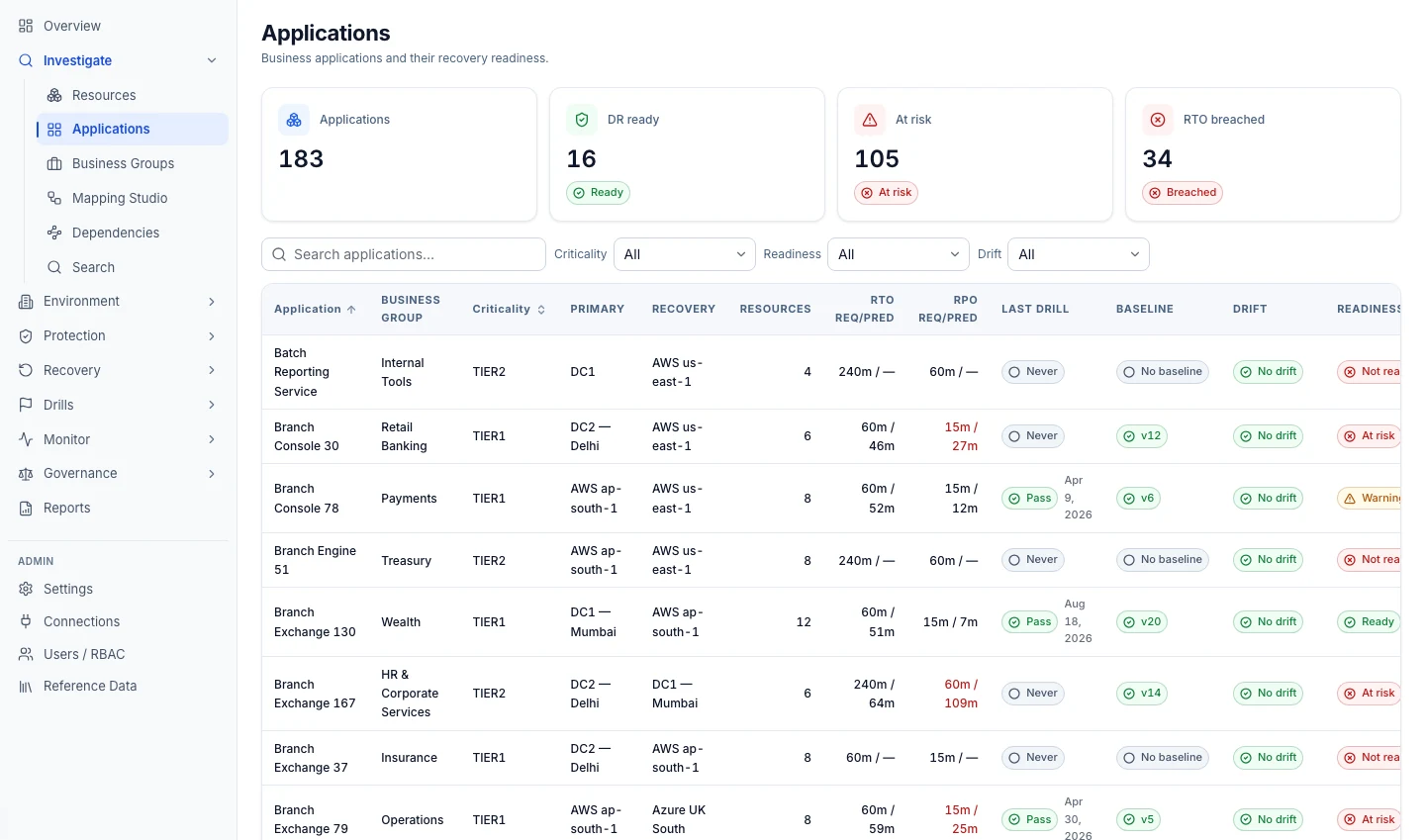
Readiness in one table
Primary and recovery site, required against predicted RTO and RPO, last drill, baseline, drift and readiness for every application.
The mechanism, step by step
What Applications & dependencies does, in the order it does it.
- 1Start from the platform inventory
DRM reads the Onam platform's cloud inventory — the same discovery Onam Estate reads — so your accounts are connected once and DRM runs no scan of its own.
- 2Propose applications from tags
Resources are grouped by the tags they carry. Infrastructure groupings such as a Kubernetes cluster are labelled as such rather than presented as business applications.
- 3Classify the dependencies
Edges come from a catalogue of how cloud resources relate to each other, and each is labelled recovery order, protection or placement.
- 4A person approves
Every proposed application and dependency arrives in the Approval Center. Nothing enters a recovery plan or a baseline until someone with approval rights accepts it.
What it does not do
Knowing where a capability stops is part of deciding whether to buy it.
Grouping is only as good as your tags
Applications are proposed from tags. An estate where only compute is tagged will produce applications that contain only compute, with databases or storage left ungrouped — tagging what an application uses is the most direct fix.
It does not execute a recovery
DRM plans, predicts and records. It does not fail anything over or start a recovery in your environment — your own tools and runbooks do that.
Questions about Applications & dependencies
More in Onam DRM
Protection
What does our cloud configuration say is actually backed up or replicated?
Explore ProtectionRecovery plans
In what order does each application come back — and is that fast enough?
Explore Recovery plansBaselines & drift
Has anything changed since we signed off the recovery plan?
Explore Baselines & driftOnam DRM
Disaster recovery management — applications and dependencies mapped, protection read from cloud configuration, predicted RTO and RPO against your targets, and drift from the plan you approved.
The whole productSee Applications & dependencies on your own cloud.
Onam DRM runs in the same console and login as the rest of Onam, with read-only access to your cloud.