Has anything changed since we signed off the recovery plan?
Onam DRM freezes each approved recovery model as a baseline and measures drift against it, so you see every difference from what you signed off — ranked by what it does to recoverability.
In your words
The recovery plan was approved for last year's audit. Since then a team added a database without a replica, another tightened a target, and a dependency moved. A change feed that compares each scan with the previous one quietly accepts all of it: a change on Tuesday looks normal by Wednesday. The question an auditor asks is different — has anything changed since the plan was approved?
What Baselines & drift shows you
Described from the product documentation — what the view holds, not what we hope it will.
Drift against the approved baseline
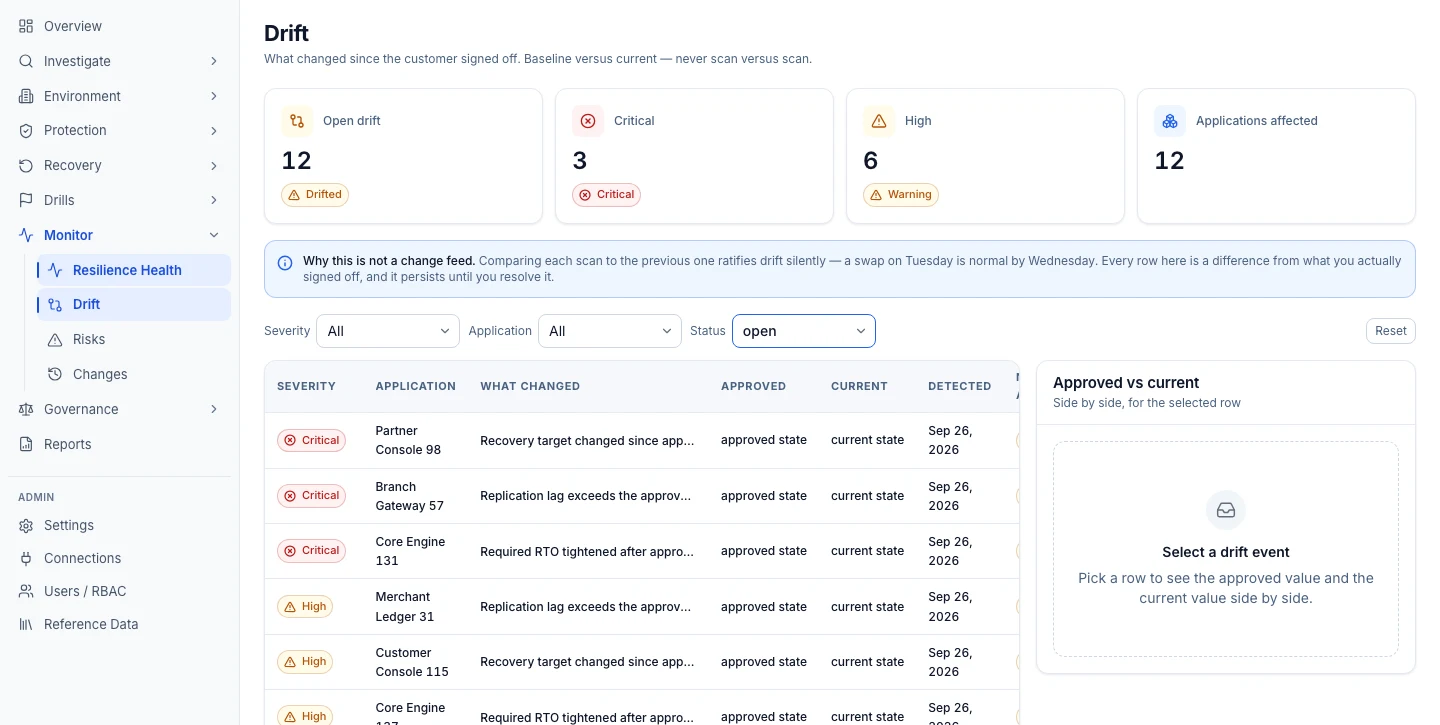
Every difference between the active baseline and the current state — never between last week's scan and this one.
Ranked by consequence
Drift is ranked by what it does to recovery: one changed recovery target outranks ten renamed steps.
Approved against current
For each drift event: the application, what changed, the approved state and the current state, side by side.
Kept until resolved
A difference stays open until someone resolves it, rather than disappearing when the next scan treats it as normal.
Structure, not noise
Baselines hold components, dependencies, protection pairings, plan steps and required targets. Live readings such as replication lag are deliberately left out of the baseline.
An enterprise view
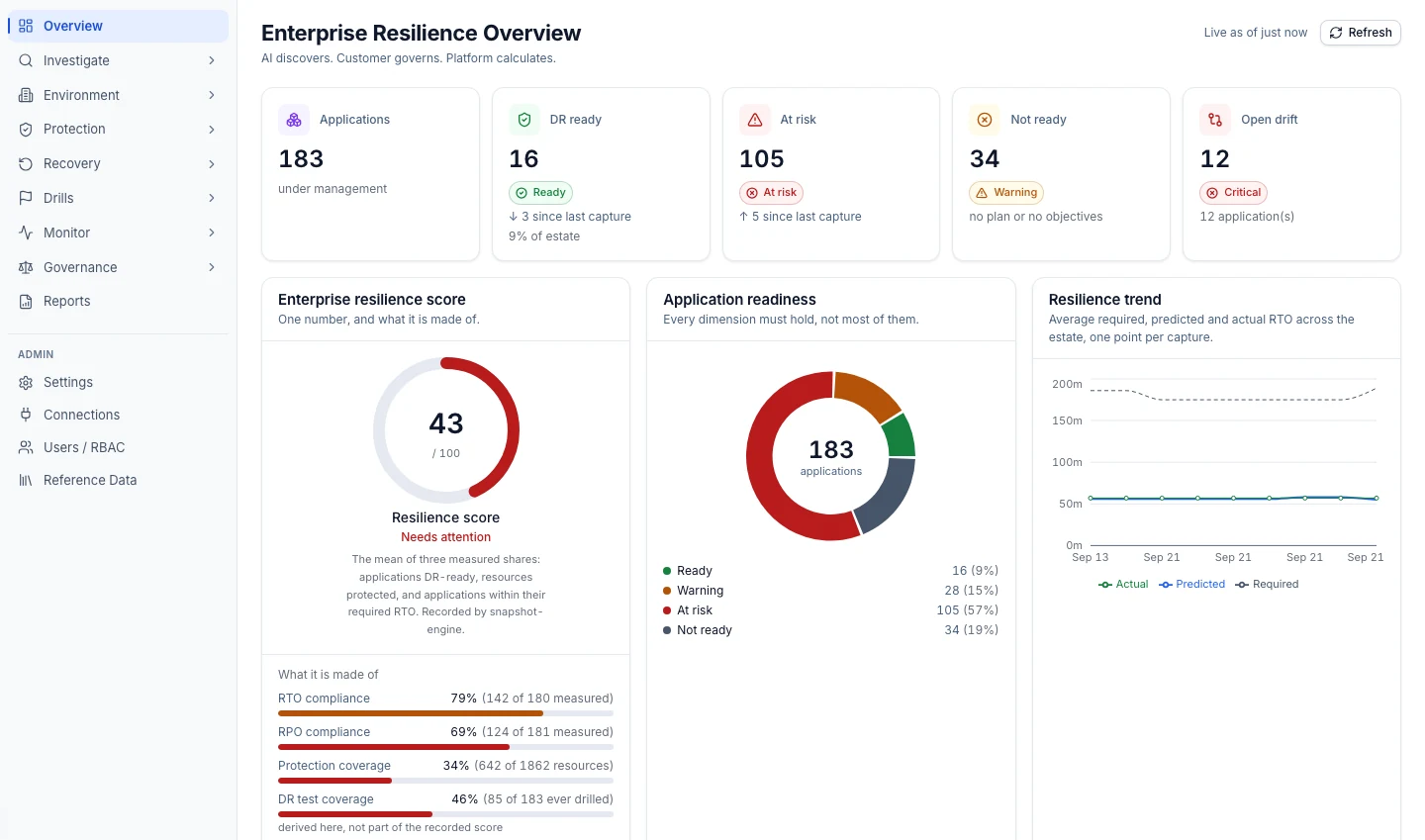
The overview brings open drift together with applications under management, readiness and a resilience score.
Baselines & drift in the console
Real screens from the console. Each tab shows the address the product serves it at.
The mechanism, step by step
What Baselines & drift does, in the order it does it.
- 1Engines propose
Applications, dependencies, protection pairings and plans arrive as proposals in the Approval Center.
- 2People approve
Someone with approval rights accepts or rejects each one. A rejected proposal is recorded and not proposed again.
- 3Freeze the baseline
Approving an application's recovery model freezes its structure and intent as a baseline.
- 4Measure drift against it
DRM compares the current state with the active baseline and ranks every difference by its consequence for recovery.
What it does not do
Knowing where a capability stops is part of deciding whether to buy it.
It does not reverse the change
DRM reads configuration and inventory and changes nothing in your cloud. Drift shows what moved since sign-off; putting it right is done by your own teams in your own environment.
It does not execute a recovery
DRM plans, predicts and records. It does not fail anything over or start a recovery in your environment — your own tools and runbooks do that.
Questions about Baselines & drift
More in Onam DRM
Applications & dependencies
Which applications do we actually recover, and what does each one depend on?
Explore Applications & dependenciesRecovery plans
In what order does each application come back — and is that fast enough?
Explore Recovery plansRTO, RPO & drills
Could we recover in time — and how do we know the number is right?
Explore RTO, RPO & drillsOnam DRM
Disaster recovery management — applications and dependencies mapped, protection read from cloud configuration, predicted RTO and RPO against your targets, and drift from the plan you approved.
The whole productSee Baselines & drift on your own cloud.
Onam DRM runs in the same console and login as the rest of Onam, with read-only access to your cloud.